Showing posts with label travel tips. Show all posts

Tuesday, April 26, 2016

Hostels of Asia

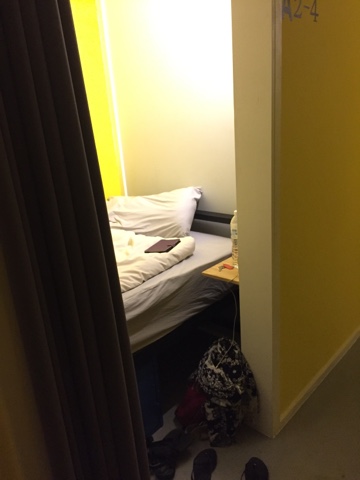
Stamps Backpackers in Chiang Mai, Thailand
Each bed was in it's own cubby with a curtain
and bedside table
Hostels often carry a reputation of being unsafe, unclean and just overall weird, especially to those who come from countries where hostels aren't as common (aka America). However, for travelers on a budget hostels are a great way to save some money while still having a safe and cozy place to sleep each night. I've stayed in my fair share of hostels throughout Europe and Asia with my most expensive being $20/night in London and my cheapest being $6/night in Bangkok.
WH Hostel in Bangkok, made up entirely
of shipping containers


There are a lot of factors when it comes to judging a good hostel including bedroom sizes, bed comfort, atmosphere, cleanliness and location. For me one of the most important factors is function and convenience. I appreciate hostels who acknowledge that their main clients are twenty-something year olds living out of suitcases. Some of my best hostel stays have included free towels, cheap laundry, cheap or free breakfast and good layouts in the bedrooms and bathrooms. Newer hostels are doing a much better job at making their accommodations practical, such as having outlets for each bunk, providing safes or luggage lockup for each bunk, and having good shelving and storage in the bathrooms. My most recent hostel in Kuala Lumpur had an ensuite bathroom and changing room for our group of 12 to share. Knowing it was just the 12 of us using the bathroom (as opposed to a whole floor of strangers) we felt safe and comfortable leaving clothes hanging in the bathroom and our toothbrushes near the sink. This hostel also provided shelves for those on the top bunk, so I had a place to keep my phone, book and water during the night. Many hostels are also getting good at accommodating electronics. It's becoming more common for each bunk to have their own set of outlets and their own reading light, these bunks often come with curtains as well, making it a little easier to feel cozy and keep things dark while going to bed. 
Personal outlet, light and lockbox for each bunk at
Twenty5 Hostel in Kuala Lumpur
There's a hostel and bedroom for practically any traveler. Many hostels offer single or double rooms incase you're not jumping at the chance to sleep in a room of strangers, and they also offer all female or all male dorms. There are party hostels which cater towards rowdier groups and often have a bar inside the lobby and offer chances to join in on bar crawls each evening. I've stayed at hostels that have clubs in the basement and host beer pong competitions each evening and I've also stayed at hostels with a strict "quiet zone" rule at night and I have even stayed at a few that don't allow any alcohol on the premises. 
I do my research before staying somewhere new, and I almost exclusively book from Hostel World, which gives honest reviews and ratings from previous guests. In all of my years of hostel stays I've never felt unsafe or uncomfortable in any situation and honestly when it comes to traveling alone I'd much rather sleep in a room of strangers as opposed to staying in a hotel alone where no one would be able to help me if something happened. Because of hostels I've done free walking tours, learned new card games, participated in bar crawls, got educated on local foods, had epic New Year's parties and met countless people from every corner of the world. 


Tuesday, February 9, 2016

Travel Gear

I've been very fortunate in my past travels to know people abroad, allowing me a free place to stay internationally. Through the kindness of others I've often received airport pickups as opposed to trekking through public transportation, which has resulted in little thought to my luggage. For my first trip to Europe I bought the biggest wheeled suitcase possible and filled it to the brim, and have since used that suitcase for the majority of my travels. However, recently I've become a little more adventurous in my travels. I've been staying in many more hostels and instead of having a home base abroad, I instead am always on the move, starting in one place and ending in another. That being said it has become far less sensible to be wheeling around a huge suitcase and it was time to upgrade to something more practical. 


Last year I walked into REI and tried on half of the backpacks in the store and very happily landed on the Osprey Porter 46. It's large enough to carry everything that I need for a 3-4 week trip abroad, and the best part is that it can be broken down into a bag that fits as a carry on, saving me a lot of money in checked baggage fees. The bag has should straps, a hip belt and a strap across your chest, so if you're walking far distances it still fits comfortably. It also has the support straps on the shoulders, taking the weight off of your back which I've never felt the need to use in a city, but have used while backpacking with heavy gear. The back of the bag has small pockets for all straps to tuck into, leaving just the top and side handles, perfect for a carryon bag or to check without worry of the straps getting caught in anything. 
The thing that I like most about this bag is that it loads like a normal suitcase, as opposed to the top loading format of most other backpacks. It makes it much easier to pack and find everything that's inside without having to completely unload it each time I want to get something out. 
So far this bag has been through a five country trip to Europe, a weeklong trip to Iceland, a six week adventure through Asia and an overnight backpacking trip in Pennsylvania. Knowing the quality of Osprey and REI, I know this bag will be with me for years. 


Compression cubes from Eagle Creek
To complete my trips with my trusty backpack I've been using packing cubes, my preferred brand is Eagle Creek and I'm especially a fan of their compression bags. These pack like a normal packing cube but include an extra set of zippers along the side to flatten the bag as much as possible so it fits nicely into the suitcase. The one down side to compression cubes and packing cubes is that they can often be a little pricy, especially for a budget traveler. On my most recent journey I moved to Thailand but stopped off in Europe for a few weeks. I wanted to pack as much as needed in my backpack, so I wouldn't have to touch my other suitcase and I was in desperate need of more packing cubes but was lacking the money to purchase more. That's when I was hit with the awesome idea of using gallon sized ziplock bags! They're definitely not as durable as packing cubes, but besides that they work great for a fraction of the price. There's a chance I might actually like them a little more than packing cubes because they're clear, making it so much easier to see what's inside each bag while keeping everything super organized. 

** Update: After backpacking through Asia throughout the last month I have almost exclusively switched to using gallon sized ziplock bags. Although they're not as durable as packing cubes I love the convenience of seeing what is inside each bag without having to open it and ruin all of my organization. 


Thursday, October 8, 2015

Night trains in Europe

I recently dove into the world of night trains in Europe, and I wish I would have done so earlier because it's such a convenient form of travel.

1. You save a day on travel, because you get to your new location while you're asleep
2. Night trains are often cheaper than flying
3. You get one night of not paying for a hostel/hotel
4. Falling asleep to the sway of a train works faster than a sleeping pill

My first overnight train travel was last summer on a trip through the Baltic countries. We were trying to fit in five cities within four countries during a two week trip (I'll admit, I was being a little too ambitious while planning this trip) so the idea of overnight travel was rather appealing.

The Red Arrow Train

Thursday, September 24, 2015

Cash vs Plastic around the world


 One thing that I always try to research before traveling to a new country is if I'll be able to use debit/credit cards without any issue. The use of cards in the country determine how much foreign currency I'll take out before traveling abroad. I also find myself observing others while I'm abroad, seeing what the locals use; if everyone is using cards I find myself pulling out my own card before using cash.


I prefer to take out cash before leaving the country, mainly because it's free and Chase bank has always been able to get me whatever currency I need within 2-3 days. On rare occasions I've used ATMs
within the country, but I've found that the fee for using an American card really adds up. I've also had my fair share of card troubles while abroad. For example, ATMs in Turkey will suck your card into the machine if you leave it in for too long, and you'll get weird looks in Russia if you even move towards your credit card, because no one trusts using plastic in their country.
Below is my ranking, which doesn't have much of a system to it, but it's my interpretation of the best and worst countries for cash vs cards.

By far the two countries with the least amount of cash use are Iceland and Sweden. They both are consistently ranked for all transactions being 90% or higher in plastic. While in both countries I didn't touch a single bill, instead I paid for everything from car tolls to meals with a credit/debit card. I traveled to both countries with extreme confidence that I would survive with just my cards and wouldn't need to track down an ATM along the way.


Australia has a currency that is both water proof and rip proof, which made me want to take out some bills before venturing down under, just to see what they looked like. If it hadn't been for my curiosity I probably wouldn't have needed to take out any cash, because I used my card for almost every purchase including ferry tickets and souvenir shopping.

Next I found that Switzerland and Liechtenstein almost always have an option to pay with a card, however, the locals seem to use more cash than plastic. The smallest bill in the Swiss Franc is a ten franc bill, meaning that the coins really add up, which is heavy and annoying. I usually take out a decent amount in Swiss Francs, but attempt to make larger purchases with my card.

Countries on the euro seem to have an even mix of cash vs cards. I've stumbled upon small hotels in Italy that would only accept cash, but could easily point me in the right direction of an ATM. Train stations usually have ticket machines that accept cards, but when in the European Union I usually carry a decent amount of euros so I'm not stuck in an awkward situation.

Balkan countries have given me mixed opinions on cash vs cards. I found in Croatia that most restaurants were completely fine with using cards, but I realized that locals around me were usually paying with cash. The problem came when it was time to buy bus tickets. Even when paying for a ride half way across the country they would still only accept cash, which completely drained my wallet. Afterwards I went to the post office to mail some postcards and found they wouldn't accept my card there either, so I had to hit up an ATM before mailing anything.  I tried to keep at least the currency equivalent of $50 USD on me while wandering around Croatia. Bosnia & Herzegovina and Montenegro showed similar results as Croatia; restaurants were fine with cards but smaller tourist shops and bus stops would only accept cash.

Lowest on the list of cash friendly countries are Thailand, Turkey and Russia. As I stated above, Russia isn't considered a safe place to use cards, because systems are easily hacked, leaving your bank account at risk. I don't know anything on the security of cards in Turkey, but I found that almost everywhere I looked people were using cash instead of cards. However, I haven't been to Turkey in 5 years, so this might not be accurate anymore. Thailand, and many other Asian countries (Laos, Vietnam, and Malaysia) don't seem to be up to date on the technology that allows credit cards. In Thailand the only place I used my card during my six months there was at Tesco, which is a large department and grocery store. In many Asian countries, larger and more expensive restaurants often accept cards, but even so I still try to carry around enough cash just incase.

I prefer to be over prepared when traveling, and I also enjoy seeing new currencies, so when in doubt I take out at least a small amount of foreign currency before leaving the country. However, in this day and age the use of cards is becoming more widespread and it seems that cash flow is slowing down, especially in Europe.