Showing posts with label malaysia. Show all posts

Sunday, May 1, 2016

Unexpected happiness in Kuala Lumpur

Malaysia is located on the peninsula of mainland Asia
After my sister visited last week it was time to jet off to some of the surrounding countries of Thailand. My first plan was to head to Kuala Lumpur (KL) to meet up with Emiliya. KL was an unplanned visit in our tour of Asia, we mainly stopped there because it's in between Thailand and Indonesia and we figured it was worth a visit since we'd be passing right by it. Before landing I only knew a handful of things about the country and city: they're predominantly muslim, homosexuality is illegal, and it's humid. Honestly, I had low expectations for KL and figured a long weekend would be more than enough to get my Malaysian fix. I don't think any opinion I've had on a city has been more wrong than my uneducated opinions on KL. Within 48 hours I was falling hard for KL and already planning visits back to explore more of Malaysia.
It's important to keep in mind that although I've traveled a little while living in Thailand I've mainly spent all of my time in developing countries. Malaysia was my first experience in a developed country in over six months, so that alone was a pretty exciting endeavor for me. The majority of my time in Asia has been in Thailand, so it's been easy to compare KL to what's fresh in my memory as opposed to an American or European city.
The Petronas Towers, the world's largest twin towers
My first impressions of KL were very positive, the city itself has a good vibe and they're much more developed and clean than the crazy Bangkok I just left behind. I was grateful to see far less litter, which I can only attribute to the fact there are garbage cans everywhere (very unlike Thailand). The streets and sidewalks are well maintained and it's actually possible to walk on the sidewalk or cross the street without fear of getting hit (again, unlike Thailand). I also quickly noticed how little plastic is being wasted here. Thailand is notorious for their usage of plastic. No matter what you're buying they'll put it in a plastic bag, even if it's just a pack of gum or bottle of water. On top of that, everyone in Thailand uses plastic water bottles, going through many in a day. I immediately noticed how many people in KL were walking around with reusable water bottles, but that can be contributed to the fact that many locals in KL drink the tap water, whereas Thai tap water is unsafe for consumption. There is also much more English (and a higher level of English) in KL than I've ever found in Asia. Malaysia is much more developed than the previous places I've been, so a higher level of English is to be expected, but it was still a shocking encounter for me.
A mosque visible from the monorail line


There isn't one big thing that stands out for my love of KL, instead it's all of the little things combined. It just seems like an extremely livable city, and is much more put together than I was expecting for an Asian capital. There are plenty of places to get free drinking water, which is a necessity in 100% humidity. There are many boutiques and malls, making fashion an easy thing to come by. The streets are lined with restaurants and coffee shops, so there's always a place to stop and chat with friends, or relax in the AC for a bit. My personal favorite part was the mix of ethnicities, cultures and religions. The majority of Malaysians practice Islam, but Buddhism and Catholicism are also recognized. It was an incredible experience to be on the public rail system, whizzing past mosques and churches on the same block.
Entrance to the Batu Caves, home to
a Hindu temple

In the hopes of not sounding terribly ignorant or racist, I had a revelation that I'd like to share: Growing up in America I've basically been raised thinking that Muslim women are often wearing their hijab as a form of oppression. I've also been raised to think that Muslim societies are extremely patriarchal, and women aren't given the same opportunities as men (it doesn't help that I just finished reading I Am Malala, where these stereotypes hold true). I was amazed when I first landed in Kuala Lumpur to see women of all types in positions of authority. There were female police officers, decked out in their uniform and badges, also wearing a hijab. There were store workers, restaurant owners, security staff at the train stations; all women of different colors, backgrounds and religions, some with a hijab and some without. It was a breath of fresh air for me because I honestly thought I was going to be landing in this oppressed land, run only by men, and I was pleasantly surprised to see women in the work force as well. Now obviously I don't know the true logistics of this country, after only being there for four days, but I was glad to see that their presentation as a city came off as very well rounded and developed.
Trying out some Indian food


This Southeast Asia trip is quickly turning into a food tour for myself, and we indulged in as many new and delicious meals that we could find while in KL. Because the city is such a crazy mix of cultures they have an awesome variety in their restaurants, and I was able to try out a lot of Lebanese and Indian food. Thailand often holds the stereotype for delicious food in Asia, but I'm finding many more delicious vegetarian options the more I'm traveling. Bring on the falafel!
We really didn't do a ton of activities during our time in KL, instead we just soaked up the culture and enjoyed some of the sights near our hostel. I loved the vibes from this city and it was a really great place to just wander around and relax with a tasty meal. Everyone is friendly and very eager to practice their English and we had some really great conversations with some of the local people. Emiliya got stopped numerous times to have her picture taken with people, which we found very amusing! That's something that never gets old. I was very impressed with the people, culture and city itself in KL and I hope that I'll be able to return to Malaysia and learn more about their country.


_________________________________________________________________________________

Logistical Info

- We stayed at Twenty5 hostel which was a great experience. It's on the 25th floor of an apartment building and offers stunning views of the city skyline. It's located within five minutes of public transportation, and the hostel itself is very livable and has a great setup. Rooms were about $10/night. I briefly mentioned the layout in this post.
- Public transportation in KL is relatively cheap and very widespread. KL Sentral is the main hub of all transportation, and from there you can transfer to various lines. However, their rail system isn't the same as most others. Instead of it being all one big system, KL rail is made up of various different companies and you have to actually leave the station and go inside the mall to transfer to a new line. It was confusing at first, but once you know where you're headed it's very easy to hop on the next train.
- The train connects to the airport, costing about $10 to get into the city.
- KL is cheap. A full meal starts at just a few dollars and public transportation is under a dollar for each ride.

Tuesday, April 26, 2016

Hostels of Asia

Stamps Backpackers in Chiang Mai, Thailand
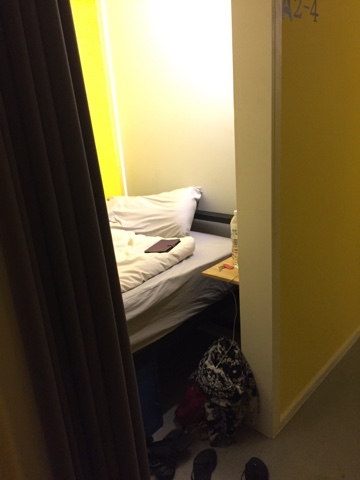
Each bed was in it's own cubby with a curtain
and bedside table
Hostels often carry a reputation of being unsafe, unclean and just overall weird, especially to those who come from countries where hostels aren't as common (aka America). However, for travelers on a budget hostels are a great way to save some money while still having a safe and cozy place to sleep each night. I've stayed in my fair share of hostels throughout Europe and Asia with my most expensive being $20/night in London and my cheapest being $6/night in Bangkok.
WH Hostel in Bangkok, made up entirely
of shipping containers


There are a lot of factors when it comes to judging a good hostel including bedroom sizes, bed comfort, atmosphere, cleanliness and location. For me one of the most important factors is function and convenience. I appreciate hostels who acknowledge that their main clients are twenty-something year olds living out of suitcases. Some of my best hostel stays have included free towels, cheap laundry, cheap or free breakfast and good layouts in the bedrooms and bathrooms. Newer hostels are doing a much better job at making their accommodations practical, such as having outlets for each bunk, providing safes or luggage lockup for each bunk, and having good shelving and storage in the bathrooms. My most recent hostel in Kuala Lumpur had an ensuite bathroom and changing room for our group of 12 to share. Knowing it was just the 12 of us using the bathroom (as opposed to a whole floor of strangers) we felt safe and comfortable leaving clothes hanging in the bathroom and our toothbrushes near the sink. This hostel also provided shelves for those on the top bunk, so I had a place to keep my phone, book and water during the night. Many hostels are also getting good at accommodating electronics. It's becoming more common for each bunk to have their own set of outlets and their own reading light, these bunks often come with curtains as well, making it a little easier to feel cozy and keep things dark while going to bed. 
Personal outlet, light and lockbox for each bunk at
Twenty5 Hostel in Kuala Lumpur
There's a hostel and bedroom for practically any traveler. Many hostels offer single or double rooms incase you're not jumping at the chance to sleep in a room of strangers, and they also offer all female or all male dorms. There are party hostels which cater towards rowdier groups and often have a bar inside the lobby and offer chances to join in on bar crawls each evening. I've stayed at hostels that have clubs in the basement and host beer pong competitions each evening and I've also stayed at hostels with a strict "quiet zone" rule at night and I have even stayed at a few that don't allow any alcohol on the premises. 
I do my research before staying somewhere new, and I almost exclusively book from Hostel World, which gives honest reviews and ratings from previous guests. In all of my years of hostel stays I've never felt unsafe or uncomfortable in any situation and honestly when it comes to traveling alone I'd much rather sleep in a room of strangers as opposed to staying in a hotel alone where no one would be able to help me if something happened. Because of hostels I've done free walking tours, learned new card games, participated in bar crawls, got educated on local foods, had epic New Year's parties and met countless people from every corner of the world. 


Thursday, September 24, 2015

Cash vs Plastic around the world


 One thing that I always try to research before traveling to a new country is if I'll be able to use debit/credit cards without any issue. The use of cards in the country determine how much foreign currency I'll take out before traveling abroad. I also find myself observing others while I'm abroad, seeing what the locals use; if everyone is using cards I find myself pulling out my own card before using cash.


I prefer to take out cash before leaving the country, mainly because it's free and Chase bank has always been able to get me whatever currency I need within 2-3 days. On rare occasions I've used ATMs
within the country, but I've found that the fee for using an American card really adds up. I've also had my fair share of card troubles while abroad. For example, ATMs in Turkey will suck your card into the machine if you leave it in for too long, and you'll get weird looks in Russia if you even move towards your credit card, because no one trusts using plastic in their country.
Below is my ranking, which doesn't have much of a system to it, but it's my interpretation of the best and worst countries for cash vs cards.

By far the two countries with the least amount of cash use are Iceland and Sweden. They both are consistently ranked for all transactions being 90% or higher in plastic. While in both countries I didn't touch a single bill, instead I paid for everything from car tolls to meals with a credit/debit card. I traveled to both countries with extreme confidence that I would survive with just my cards and wouldn't need to track down an ATM along the way.


Australia has a currency that is both water proof and rip proof, which made me want to take out some bills before venturing down under, just to see what they looked like. If it hadn't been for my curiosity I probably wouldn't have needed to take out any cash, because I used my card for almost every purchase including ferry tickets and souvenir shopping.

Next I found that Switzerland and Liechtenstein almost always have an option to pay with a card, however, the locals seem to use more cash than plastic. The smallest bill in the Swiss Franc is a ten franc bill, meaning that the coins really add up, which is heavy and annoying. I usually take out a decent amount in Swiss Francs, but attempt to make larger purchases with my card.

Countries on the euro seem to have an even mix of cash vs cards. I've stumbled upon small hotels in Italy that would only accept cash, but could easily point me in the right direction of an ATM. Train stations usually have ticket machines that accept cards, but when in the European Union I usually carry a decent amount of euros so I'm not stuck in an awkward situation.

Balkan countries have given me mixed opinions on cash vs cards. I found in Croatia that most restaurants were completely fine with using cards, but I realized that locals around me were usually paying with cash. The problem came when it was time to buy bus tickets. Even when paying for a ride half way across the country they would still only accept cash, which completely drained my wallet. Afterwards I went to the post office to mail some postcards and found they wouldn't accept my card there either, so I had to hit up an ATM before mailing anything.  I tried to keep at least the currency equivalent of $50 USD on me while wandering around Croatia. Bosnia & Herzegovina and Montenegro showed similar results as Croatia; restaurants were fine with cards but smaller tourist shops and bus stops would only accept cash.

Lowest on the list of cash friendly countries are Thailand, Turkey and Russia. As I stated above, Russia isn't considered a safe place to use cards, because systems are easily hacked, leaving your bank account at risk. I don't know anything on the security of cards in Turkey, but I found that almost everywhere I looked people were using cash instead of cards. However, I haven't been to Turkey in 5 years, so this might not be accurate anymore. Thailand, and many other Asian countries (Laos, Vietnam, and Malaysia) don't seem to be up to date on the technology that allows credit cards. In Thailand the only place I used my card during my six months there was at Tesco, which is a large department and grocery store. In many Asian countries, larger and more expensive restaurants often accept cards, but even so I still try to carry around enough cash just incase.

I prefer to be over prepared when traveling, and I also enjoy seeing new currencies, so when in doubt I take out at least a small amount of foreign currency before leaving the country. However, in this day and age the use of cards is becoming more widespread and it seems that cash flow is slowing down, especially in Europe.